[cryptowp price="bitcoin"]


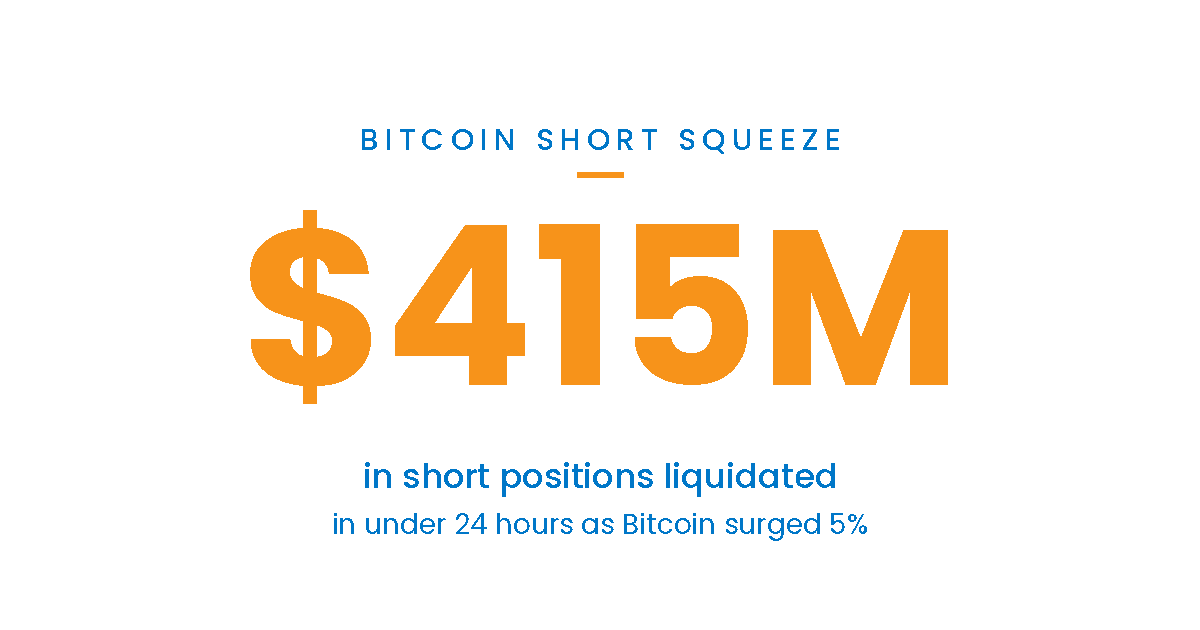
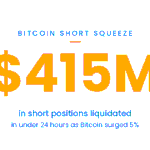
On Wednesday Bitcoin was sitting around $77,300, barely moving. By Thursday morning it was above $81,000 — a nearly 5% move that wiped out $415 million in short positions across crypto derivatives, with $164 million of that gone inside a single four-hour window. Longs lost $7.3 million in the same window. That gap tells you everything: this wasn’t “the market went up.” This was one side of the trade getting run over.
The trigger was straightforward. US-Iran tensions had been escalating for weeks, crude oil spiked past $96 a barrel, and Bitcoin had been sliding under the weight of it. When those tensions paused, the pressure came off all at once. Bitcoin’s market cap crossed $1.62 trillion for the first time this month. Fed Governor Christopher Waller said he’d support leaving rates unchanged as long as inflation doesn’t shift dramatically, and that got read as a dovish signal on top of the geopolitical relief. Bitcoin ETFs pulled in $101 million that day, and the Fear and Greed Index swung from “extreme fear” a month ago to “greed” now. None of that changes the bigger picture — Bitcoin is still down about 30% year over year and nowhere near its all-time high — but it was more than enough to break a crowded position.
Here’s the part worth sitting with. Waller is one voice on the FOMC. The market is still pricing a 50.5% probability of a rate hike — basically a coin flip. One governor’s comment didn’t settle anything. What it did was give a market that was already leaning heavily short an excuse to unwind fast, and once liquidations start, they force more liquidations — each forced buy-to-cover pushes price up further, which triggers the next batch of stops. That’s the mechanic behind a $164 million move in four hours. It’s not really about Iran or Waller. It’s about how many people were positioned the same way going in.
I recognize this pattern because I’ve been on the wrong side of it myself, just with a different instrument. Back in 2018 I traded binary options and had a strategy that worked well — I was running around 100 trades a day and doubled my account in two weeks. That result made me confident enough to risk more per trade than I should have, and when the market moved against that sizing, it wiped the account to zero. The strategy wasn’t the problem. The size was. Watching $415 million disappear in a matter of hours this week is the same lesson at institutional scale.
So what do you actually do with that. First, treat a single-source catalyst — one central bank official, one geopolitical headline — as information, not as a reason to hold outsized exposure into it. A 50.5% probability isn’t a signal, it’s a coin flip dressed up as one. Second, before adding to a position that’s already crowded in one direction, it’s worth checking funding rates or open interest skew — a squeeze like this one is rarely a surprise if you’re looking at how lopsided the positioning already is. Third, set your stop-loss before you enter, not after the move against you has already started; a level decided in the middle of a 5% swing is not a plan, it’s a reaction. And now that Bitcoin is testing $81,000, the next number that matters is $83,000 — analysts are flagging it as the level where this either turns into a real breakout or a trap for everyone who bought the squeeze late.
The money that got wiped out this week wasn’t lost because Bitcoin moved. It was lost because positions were sized for a market that was expected to stay calm.
Source: Bitcoin.com News — “Bitcoin Price Barrels Toward $81K as Shorts Lose $415M”